

Welcome!
The Beat Saber World Cup is a yearly country-based tournament featuring the very best players of each country. It is hosted by Cube Community and broadcasted on Twitch. You can find all the information below.
Prizes
1st - Badge + 50% of total prize pool
2nd - Badge + 30% of total prize pool
3rd - Badge + 20% of total prize pool
All players and team captains will receive a badge if their team places in the top three.
All players on the top three teams will receive an even split of their placement's prize pool. If the players would like to split the money any other way, there will need to be a 100% agreement on how to split it. This will be discussed at the time of payouts.
Registration
Every player must register on the website.
There may only be one team per country. Team Captains will be chosen by their country by whichever way they see fit. Once a Team Captain has been chosen for your country, they will need to register their country in the appropriate Discord channel when it opens.
Team Captains will be responsible for submitting their rosters until the Roster Lock-in Date (refer to the schedule) and prepare the roster reveal video if they wish to submit one. Once a roster is locked in, it cannot be changed. Once rosters are locked in, all registered teams will have their full rosters made public on the website right after the roster reveal videos have been premiered.
You cannot play in this tournament if:
You are on PSVR
You are on Quest without a link cable
You are banned from submitting scores to ScoreSaber and/or Beat Leader
Players are required to maintain their registered usernames throughout the tournament. Any permanent username changes must be reported to the tournament admins immediately. Changing usernames to "joke" usernames can confuse viewers and casters, and is prohibited. Players who change their usernames without notification will not be allowed to play until they reinstate their original username.
Qualifiers
All signed up teams will have approximately 2 weeks to play the qualifiers map pool. The map pool is due to be revealed one week before the beginning of the qualifiers. Each player will have 3 attempts on each map of the pool. Launching the map will deduce one attempt, even if the player doesn't finish the map.
Qualifiers will be held with the Tournament Assistant (v3) plugin. The plugin will be given to all participants in a public Discord channel. You only need one plugin for the entire tournament.
The qualifier standings will be determined by a team average "weighted score" for the top 3 scores on each qualifier map. The weighted score is calculated with the following formula:
f(x) = ((m - x) / (m - o))
m: the map's max score
o: the number one score in the leaderboard
x: the score
The formula essentially gives a "weighted score" based on the top score on the map. The closer you are to the max or the number one score, the less "weighted score" you are awarded, the better.
After qualifiers have finished, the top 16 teams of the standing will move to the Round of 16 bracket phase.
Special thanks to EUC for establishing this formula.
Scheduling
All matches will take place on the weekend (Friday, Saturday, Sunday - subject to change in extenuating circumstances), this is to ensure that all matches can be streamed.
Match scheduling will be decided by cooperation between the Team Captains as well as the tournament staff.
While any time is fine during the weekend, the ideal situation is for all matches in a specific weekend to take place as close to each other as possible.
Once both teams agree on a time, they will get in contact with a tournament admin or a head coordinator at least 48 hours prior to their agreed upon match time.
Once a match time has been agreed upon by both teams, the coordinators, the referee and the stream host, any changes must also be submitted 24 hours before the originally scheduled date and time.
Rescheduled matches, again, need to be agreed upon by all parties.
Mods & Scoring
All players will play in No Fail mode. Scores will be taken from the in-game scoring system. The winner will be decided by which team has the highest combined total score.
The following mods/plugins are banned from use in the tournament.
Intro/Outro Skip*
Note Slice Visualizer
Song Chart Visualizer
Old Notes
Any mod/plugin that affects scoring ability
Any mod/plugin that disables score submission
Any mod/plugin that interferes with TournamentAssistant v3
* We will show leniency towards the appearance of the Intro/Outro Skip UI. Although, it is NOT to be used while in a map to prevent any issues that may occur with player stream synchronization with the POVs as well as the live tug of war.
Hiding arcs on V3 maps is tolerated but we are not responsible if a player misses key gameplay elements.
All chat mods are highly recommended to be removed, but not strictly enforced. The use of such mods can induce mid-match game crashes and general instability.
If a map starts and a player is seen to be using a banned mod, the map will be played normally but the offending player's score will be set to zero and will not count. There will be no free replays offered for this occurrence. If either Team decides to replay, the offending player will not be allowed to replay.
If the tournament staff are able to identify a banned mod before the map begins, they will ask the player to remove the mod and continue. This must be done in a relatively quick time frame (specifics are determined by the referee). If the player doesn't remove the mod, the score will be set to zero and not count.
To clarify, it is NOT the tournament staff's responsibility to identify your banned mods. Players and Captains are responsible for identifying, disabling and/or uninstalling the banned mods prior to the match. Free replays or leniency will not be given for tournament staff not identifying a banned mod.
Broadcasting
All games in the bracket stage must be streamed to our RTMP server. Information will be given out to qualified teams and players in due course.
Streams may not have obstructive overlays due to the stream sync technology that we're using. In the same vein, streams must all be in first person view.
We will not be allowing third person or avatar use.
A Camera2 config file as well as OBS settings will be given out to all qualified competitors to homogenize the viewing experience.
The use of the classic OBS (not Streamlabs OBS) is recommended for stability, ease of configuration & troubleshooting.
Match Flow
Matches will be managed with moon's Tournament Assistant plugin along with our own integration. Players must make sure that they can connect and play maps with the mod.
All coordinators, the referee, the team captain and players should connect to the voice channel ahead of their scheduled play time. There will be a 15 minute grace period for players to arrive if their team has less than the required amount of players to play a match (3 players).
Players must also connect to Tournament Assistant and choose the "Beat Saber World Cup" tournament upon connecting. If the team captain is not available, a player or external party may substitute. A special Discord role will be given out by the referee to grant access to the "current-match-text" and both voice channels for the teams & coordinators.
Each Team Captain will send their coordinator the map their team has chosen for their warm up. We will do our best to play them in order of higher seed, then the lower seed (as a reminder, the highest seed in the tournament is 1, and the lowest is 16). Neither team is required to play the warmup songs, and if both teams agree that no warmup will be played, they may proceed to the next step. Warmup maps must not violate the Twitch Terms of Service (Referee Discretion) and should not be more than 5 minutes long. Please note that warmups may be skipped if the schedule is running late, this decision is taken by the match referee.
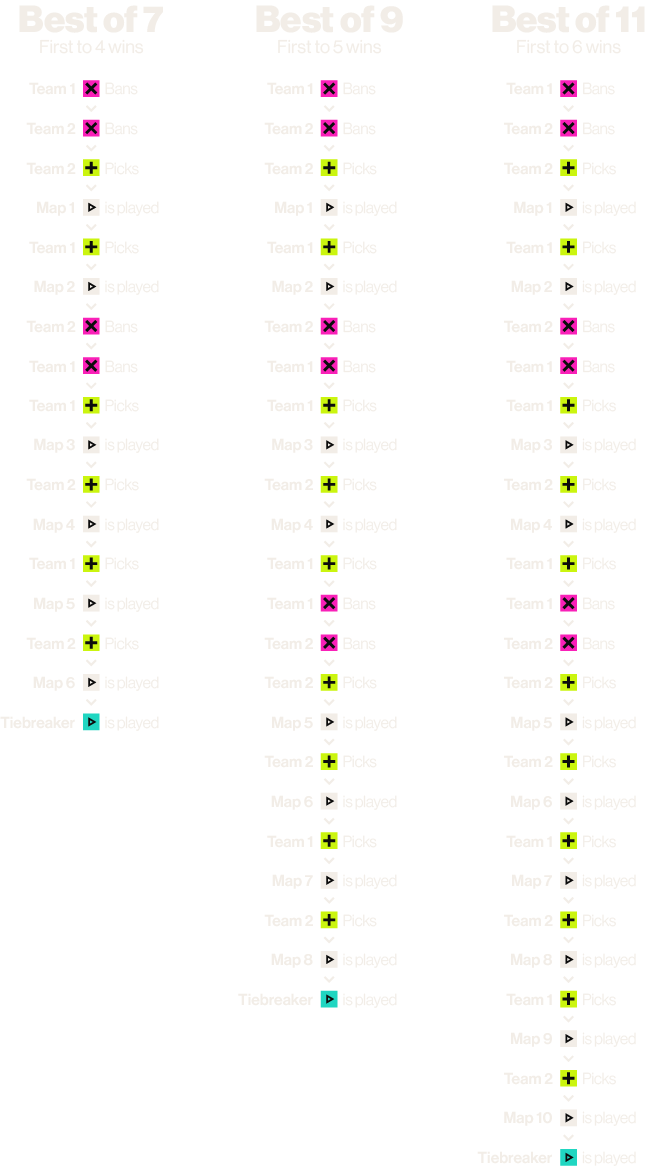
After the warmups, Team Captains will be rolling a random number in the "current-match-text" channel. The Team Captain with the highest roll will choose strategically between "Team 1" or "Team 2" to decide the pick & ban order. Team 1 will always ban first and pick second. Team 2 will always ban second and pick first.
The above flow will be followed until a winner is decided.
In order to pick or ban, the Team Captain will communicate their choice orally to the team's coordinator. The coordinator will then do the necessary to communicate & update the website accordingly. The referee will ensure that this process is done smoothly.
After a map is picked, it will be immediately played by both teams. Team Captains will need to decide on the roster for each map played and communicate accordingly with the coordinator in order for them to do the necessary. Each team will have 4 players (3 is the absolute minimum). You may only choose to use 3 players if there are only 3 players present. If there are 4 or more, you must have 4 players play. If 4 players participate in the match, the lowest score will be dropped from each team that used 4 players. If you can only field 3 players, all scores will count.
Maps can only be chosen once, either through ban or pick. If one map remains, it is played as the "tiebreaker". Some rounds (such as Grandfinals) may "force" a tiebreaker, which means that the map cannot be picked or banned. If those forced tiebreakers are not played, the referee can offer a showmatch if both teams agree on a roster.
If you have 3 players, you must begin the match regardless of who those players are (planned starters, subs, etc.). If you cannot field a team of at least 3 players before the 15 minute grace period has ended, it will be considered as a forfeit and an automatic match loss.
During the match, if a player disconnects, loses power, or any other event which causes the team to dip below the minimum required number of players, an additional 10 minute grace period will be granted in order to allow the player to reconnect. If this happens too often, the match can either be called or the player may not be admitted in subsequent maps. This decision is taken by the referee.
In any case, if a player disconnects from the match lobby during a map, the rest of the map will be played as normal by everyone else and the player who disconnected will not have their score added to their team's total.
Both teams will play to the best of their abilities during all matches. This means that any intentional disruption during the matches such as "throwing" or streaming content other than their own Beat Saber gameplay on the current map during the match will be seen as unsportsmanlike. At the tournament staff's discretion, the map can be ended immediately and will result in a map loss. There will be NO OPTION to replay.
In the same spirit, someone may not play for anyone else during the tournament. Players must play on their own account during the tournament.
The map winner is decided by the sum of the top 3 scores of each team. After each map, the referee will confirm the winners of each map and their total scores. A replay can be called at this stage by the losing team. Once the scores are confirmed, the players are freed from the match lobby and follow onto the next step. Players may not leave the lobby until the confirmation of the referee.
In fact, each team will be able to replay any map for any reason ONCE. A replay can only be called by the map's losing team. At the end of each map, the Team Captain of the losing team will decide on whether to call a replay or not. Players may discuss with their captain to decide on the call and on the potential roster as substituting players for a replay is